How to Import Cars from Guangzhou and Shenzhen, China: A Practical Guide for Overseas Buyers
Guangzhou and Shenzhen are two of the most important automotive and logistics hubs in South China. For overseas buyers looking for used cars, SUVs, hybrids, EVs or fleet vehicles from China, the Guangzhou-Shenzhen area offers access to a large vehicle supply network and major export ports. This guide explains how the buying process works, how vehicles are inspected, the difference between Guangzhou and Shenzhen logistics, and what buyers should prepare before placing an order.
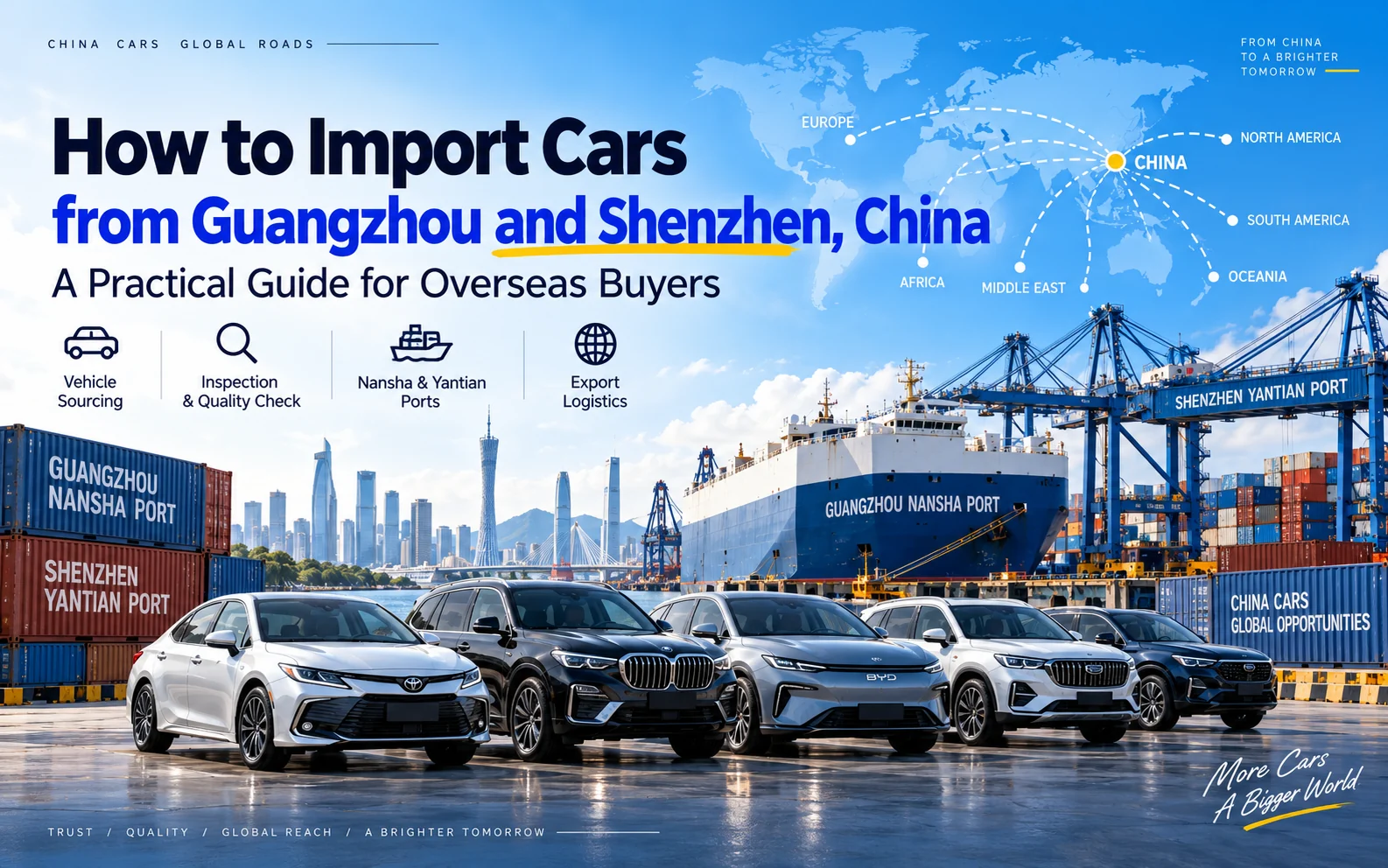
If you are planning to import a car from China, Guangzhou and Shenzhen are two locations you will hear about frequently.
They are both located in the Pearl River Delta, one of China's most important manufacturing, trading and logistics regions.
But overseas buyers sometimes misunderstand what "buying a car from Guangzhou" or "buying a car from Shenzhen" actually means.
The vehicle may not be sitting beside the port.
It may be sourced from Guangzhou, Shenzhen, Foshan, Dongguan or another nearby city, inspected at a vehicle yard, prepared for export, and then transported to the port that offers the most suitable shipping route.
For buyers, the important thing is not simply which city the car is located in.
What matters is:
finding the right vehicle
confirming its real condition
checking whether it can be imported into your country
understanding the quotation
completing the export process correctly
choosing a suitable shipping route
Here is how the process normally works.
Why Buy Cars from Guangzhou and Shenzhen?
Guangzhou and Shenzhen are part of the Greater Bay Area, with a large automotive supply chain around them.
This gives overseas buyers access to many different types of vehicles, including:
Toyota
Honda
Hyundai
Volkswagen
Nissan
Lexus
BYD
Geely
Chery
GAC
Changan
used sedans
SUVs
MPVs
hybrids
electric vehicles
commercial vehicles
The advantage is not that every vehicle is physically located inside Guangzhou or Shenzhen.
The real advantage is access to the wider South China vehicle market.
If a buyer asks us for a Toyota Corolla, Honda CR-V, Toyota RAV4, Hyundai Tucson or a Chinese EV, we can check different sources instead of relying on one small local inventory.
This is especially useful for dealers who need several vehicles with different model years, mileage ranges and budgets.
Guangzhou and Shenzhen Are Different Export Hubs
Although the two cities are close to each other, their role in vehicle export is not exactly the same.
Guangzhou and Nansha Port
Guangzhou is particularly important for vehicle exports through Nansha.
Nansha has developed a complete automotive export ecosystem covering vehicle preparation, inspection, export procedures, storage, customs handling and port logistics.
For many vehicle shipments from South China, especially when RoRo shipping is available, Nansha can be a practical export option.
Used vehicles sourced from Guangzhou and surrounding cities can be transported to the export yard, prepared, cleared and then moved to the port according to the vessel schedule.
Shenzhen and Yantian Port
Shenzhen has a strong international logistics network and is particularly important for container shipping.
Yantian Port is connected to a large number of international container routes, making Shenzhen useful for vehicles that are shipped by container or combined with other export logistics arrangements.
Shenzhen is also closely associated with China's electric vehicle and new-energy vehicle industry.
For buyers interested in Chinese EVs, plug-in hybrids and newer Chinese brands, Shenzhen and the surrounding Greater Bay Area can be an important sourcing region.
However, the port should not be selected only because the vehicle was purchased in that city.
The final port depends on the destination, shipping method, vessel schedule, freight rate and vehicle type.
Step 1: Tell the Exporter Exactly What You Need
One of the biggest mistakes buyers make is sending a message such as:
How much is a Toyota?
That is not enough information to provide a useful quotation.
Instead, send the supplier as much information as possible.
For example:
I am looking for a 2019-2021 Toyota Corolla for Ghana. Mileage below 100,000 km. My target budget is around USD 6,000 EXW. Please send available cars with photos and condition details.
A useful inquiry should include:
destination country
destination port, if known
brand and model
preferred registration year
mileage range
quantity
fuel type
left-hand drive or right-hand drive
target budget
EXW or FOB preference
For dealers, it is also helpful to explain which models sell well in your local market.
The more specific your requirements are, the easier it is to find suitable vehicles.
Step 2: Search for the Right Vehicle
Once the requirements are clear, the next step is vehicle sourcing.
For used vehicles, price can vary significantly even between two cars of the same year and model.
For example, two 2020 Toyota Corollas may have different:
mileage
accident history
paint condition
interior condition
trim level
maintenance history
tire condition
mechanical condition
This is why the cheapest vehicle is not always the best vehicle to export.
For overseas buyers, we prefer to compare the complete vehicle condition rather than simply searching for the lowest advertised price.
A slightly more expensive car with better condition can often be easier to sell after it reaches the destination market.
Step 3: Check the Vehicle Before You Buy
This is one of the most important parts of the process.
When you are thousands of kilometres away from China, you should not make a decision based only on several listing photos.
Ask for real information about the exact car.
Before confirming a used vehicle, important items to check include:
VIN
registration date
mileage
exterior condition
accident or repair information
engine condition
transmission condition
dashboard warning lights
interior condition
tires
chassis
air conditioning
electronic functions
We also recommend requesting actual photos and a walk-around video.
When necessary, ask for a cold-start video, engine-bay video or road-test video.
If the vehicle has scratches, dents or repaired panels, it is better to see them before payment.
A used car does not need to be perfect.
The important thing is that the buyer understands what he is buying.
Step 4: Confirm Whether the Car Can Be Imported into Your Country
Finding a good vehicle in China does not automatically mean it is suitable for your market.
Different countries have different import regulations.
Before buying, check requirements such as:
maximum vehicle age
first registration date
left-hand or right-hand drive restrictions
engine capacity rules
emissions standards
EV requirements
inspection requirements
import permits
local homologation requirements
customs duties and taxes
This is especially important for used cars.
For example, some countries calculate vehicle-age limits from the first registration date rather than simply looking at the model year.
A buyer may ask for a 2021 vehicle, but the exact registration month can determine whether the vehicle is still eligible for import.
Always check this before shipping.
Step 5: Understand the Quotation
When buying from Guangzhou or Shenzhen, you may receive different types of quotations.
The two terms we use most often with overseas vehicle buyers are EXW and FOB.
EXW
An EXW quotation is useful when the buyer already has his own freight forwarder or logistics partner in China.
The buyer's logistics company normally takes over the transportation and shipping process from the agreed location.
FOB
Under an FOB arrangement, the exporter handles the agreed China-side export process and delivers the vehicle according to the FOB terms at the agreed port.
FOB can be more convenient for buyers who do not already have their own vehicle-export logistics arrangement in China.
Before paying, always ask:
What exactly is included in this price?
Do not assume that vehicle price, inland transport, port charges and ocean freight are all included.
A clear quotation should make the trade term clear.
Step 6: Confirm the Vehicle and Payment Terms
After the buyer selects a vehicle, the vehicle information should be confirmed before payment.
This normally includes:
make
model
VIN
registration year
mileage
vehicle condition
price
Incoterm
payment terms
destination
The exact payment arrangement depends on the supplier and transaction.
For overseas buyers, the most important point is that the vehicle and commercial terms should be clearly identified before money is transferred.
If something has not been confirmed, ask before paying.
Step 7: Complete the Used-Car Export Procedures
Used-car export from China is a formal process.
The vehicle must meet applicable export requirements, and the required vehicle registration, inspection, export licensing and customs procedures must be completed.
Exported used passenger vehicles are also subject to China's used-vehicle export quality requirements and third-party inspection requirements.
For buyers, this is one reason why working with an exporter familiar with the actual export process matters.
Buying a car is only the first step.
The vehicle still needs to become an export-ready vehicle.
Depending on the transaction, the process can involve:
Vehicle purchase
Ownership and export-related registration procedures
Vehicle inspection
Export license application
Export documentation
Inland transportation
Customs declaration
Port delivery
Loading
Final vehicle registration cancellation procedures in China
The buyer does not normally need to handle every China-side step personally, but should understand that these steps exist.
A Special Note About Very Recently Registered Vehicles
Buyers should also pay attention to vehicles that were registered very recently in China.
Current Chinese rules place additional requirements on vehicles with a very short period between first registration and export as a used vehicle.
This is particularly relevant when buyers are looking for almost-new vehicles with extremely low mileage.
If you want a vehicle that is only a few months old, confirm its export eligibility before placing an order.
Do not assume that registering a new vehicle automatically makes it a normal used vehicle for export purposes.
Step 8: Transport the Vehicle to the Port
After the vehicle is ready for export, it needs to be transported to the appropriate port or logistics facility.
A vehicle purchased in Guangzhou does not necessarily have to leave China from Guangzhou.
Likewise, a vehicle sourced in Shenzhen does not always need to leave from Shenzhen.
For example, a vehicle may be sourced in Guangzhou but shipped through a Shenzhen container route if that option makes more sense.
Another vehicle may be sourced elsewhere in Guangdong and exported through Nansha because of a suitable RoRo sailing.
The export route should be decided based on logistics, not simply the city where the car was purchased.
Nansha or Yantian: Which Port Is Better?
There is no single answer.
Nansha may be suitable when:
a convenient RoRo route is available
the vehicle is already in the Guangzhou area
several vehicles are being prepared together
the destination has suitable vehicle-shipping connections
Yantian may be suitable when:
container shipping is preferred
the shipping line offers a better route
the buyer is shipping multiple vehicles or other cargo
the destination is better served by Shenzhen's container network
Other South China ports may also be considered depending on the shipment.
A professional exporter should compare the actual shipping options instead of automatically using the same port for every order.
RoRo vs Container Shipping
Cars from Guangzhou and Shenzhen can be shipped in different ways.
RoRo
RoRo means Roll-on/Roll-off.
Vehicles are driven onto a specialized vessel and driven off at the destination.
For destinations with regular RoRo services, this can be a convenient way to ship vehicles.
Container
Cars can also be loaded into shipping containers.
Container shipping is commonly considered when:
RoRo is unavailable
several vehicles are shipped together
the destination has strong container connections
the buyer wants a container-based logistics solution
Shipping availability and freight rates change, so the best option should be checked for each shipment.
Step 9: Check the Shipping Documents
Before the vehicle arrives at the destination, buyers should carefully review the shipping and commercial documents.
Depending on the shipment and destination, documents may include:
commercial invoice
sales contract
packing list
vehicle information
inspection-related documents
export documents
Bill of Lading
Certificate of Origin, where applicable
destination-specific certificates
Check that important information is correct.
In particular:
buyer or consignee name
VIN
vehicle model
destination port
shipping information
A small document error can create a much larger problem during customs clearance.
Step 10: Customs Clearance in the Destination Country
China-side export procedures and destination-country import procedures are two different things.
Once the vehicle arrives, the buyer may still need to handle:
customs clearance
import duty
VAT or local taxes
port charges
inspection
registration
local transport
These costs depend on the destination country.
This is why an FOB price should not be confused with the final landed cost.
Before buying, we recommend speaking with a local customs broker if you are unsure about your country's import taxes or registration rules.
Which Cars Are Commonly Requested by Overseas Buyers?
Requirements vary by country, but we regularly see overseas buyers looking for models such as:
Toyota Corolla
Toyota Camry
Toyota RAV4
Toyota Highlander
Toyota 4Runner
Honda Accord
Honda CR-V
Hyundai Elantra
Hyundai Tucson
Volkswagen Tiguan
There is also growing interest in Chinese vehicles and new-energy vehicles, including:
BYD
Geely
Chery
Changan
GAC
Jetour
other Chinese EV and hybrid models
The best car is not necessarily the most popular car in China.
It should be a model that makes sense in your destination market.
For dealers, local resale demand, spare-parts availability and maintenance costs should be considered before purchasing.
Can You Buy Only One Car?
Yes.
You do not necessarily need to buy a full container or a large fleet.
Individual buyers can purchase one vehicle, while dealers may purchase several vehicles at a time.
However, the shipping cost per vehicle and available logistics options may be different depending on quantity.
If you are buying several cars, tell the exporter from the beginning.
It may allow the vehicles to be sourced and shipped more efficiently.
What Should You Send When Asking for a Quote?
If you want a useful quotation, send the following information:
Country
Destination port
Vehicle model
Registration year
Quantity
Mileage requirement
Budget
EXW or FOB
Any special condition requirements
For example:
I am a dealer in Angola. I need three Toyota RAV4 vehicles, first registered in 2022 or later, mileage below 80,000 km. Please quote EXW and FOB and send available vehicle photos.
This is much better than simply asking:
RAV4 price?
With clear requirements, the exporter can search for vehicles that actually match your market and budget.
Why Guangzhou and Shenzhen Work Well Together
For overseas vehicle buyers, Guangzhou and Shenzhen should not necessarily be viewed as two competing sourcing locations.
They are part of the same broader South China automotive and logistics network.
A vehicle may be sourced in Guangzhou.
Another may come from Shenzhen or Dongguan.
Inspection may take place at a separate vehicle yard.
The shipment may leave through Nansha, Yantian or another suitable port.
What matters is building the most practical route from:
Vehicle sourcing → Inspection → Export preparation → Port → Shipping → Destination
That is more important than insisting that every part of the transaction happens in the same city.
Frequently Asked Questions
Can foreigners buy used cars from Guangzhou or Shenzhen?
Yes. Overseas buyers can purchase vehicles for export through a qualified vehicle exporter. The exporter handles the required China-side export procedures according to the transaction arrangement.
Is Guangzhou better than Shenzhen for buying used cars?
Not necessarily.
Both cities provide access to the wider South China automotive market.
Guangzhou has strong vehicle-export infrastructure around Nansha, while Shenzhen has extensive international container logistics and a strong new-energy vehicle ecosystem.
The best option depends on the vehicle and destination.
Can I inspect the vehicle before payment?
You should ask for actual vehicle information before making a final decision.
This may include photos, videos, mileage, VIN, vehicle condition and inspection information.
For some transactions, independent third-party inspection can also be considered.
Can cars from Guangzhou be shipped from Shenzhen?
Yes.
The sourcing city and export port do not always have to be the same.
The shipping port can be selected according to vessel availability, destination, freight cost and shipping method.
Can cars from Shenzhen be shipped through Nansha Port?
Yes, depending on the logistics arrangement.
Vehicles can be transported between cities in the Greater Bay Area before export.
Can I buy Chinese electric vehicles for export?
Yes, but the exact export eligibility, charging standard, battery condition, destination-market regulations and after-sales support should be checked before purchase.
What is the difference between EXW and FOB?
EXW generally gives the buyer more responsibility for China-side logistics, while FOB includes more of the export and port-delivery process on the seller's side.
Always confirm exactly what is included in the quotation.
Which countries can cars from Guangzhou and Shenzhen be shipped to?
Vehicles are exported from South China to markets in Africa, the Middle East, South America, Asia and other regions.
Actual shipping routes depend on the destination port and current vessel schedules.
Looking for Cars from Guangzhou or Shenzhen?
If you are planning to import vehicles from China, send us your requirements.
Please include:
destination country
vehicle model
preferred year
quantity
mileage requirement
target budget
EXW or FOB
We can check available vehicles in Guangzhou, Shenzhen and the surrounding South China market and provide actual vehicle information, photos, mileage and condition details.
We can also help you understand the China-side vehicle inspection, export and shipping process before you place an order.
For buyers who are new to importing vehicles from China, you can also read our guide:
How to Import Used Cars from China: A Step-by-Step Guide for Overseas Buyers
If vehicle condition is your main concern, see:
How to Check a Used Car Before Buying from China: A Practical Guide for Overseas Buyers
And if you are not sure about the trade terms, read:
EXW vs FOB vs CIF vs DDP: Which Shipping Term Is Best When Importing Cars from China?