How to Check a Used Car Before Buying from China: A Practical Guide for Overseas Buyers
Buying a used car from China can offer good value, but vehicle condition matters more than a low price. This guide explains what overseas buyers should check before purchasing, including mileage, accident repairs, engine and transmission condition, interior wear, tires, chassis, VIN information, inspection reports, photos, and videos.
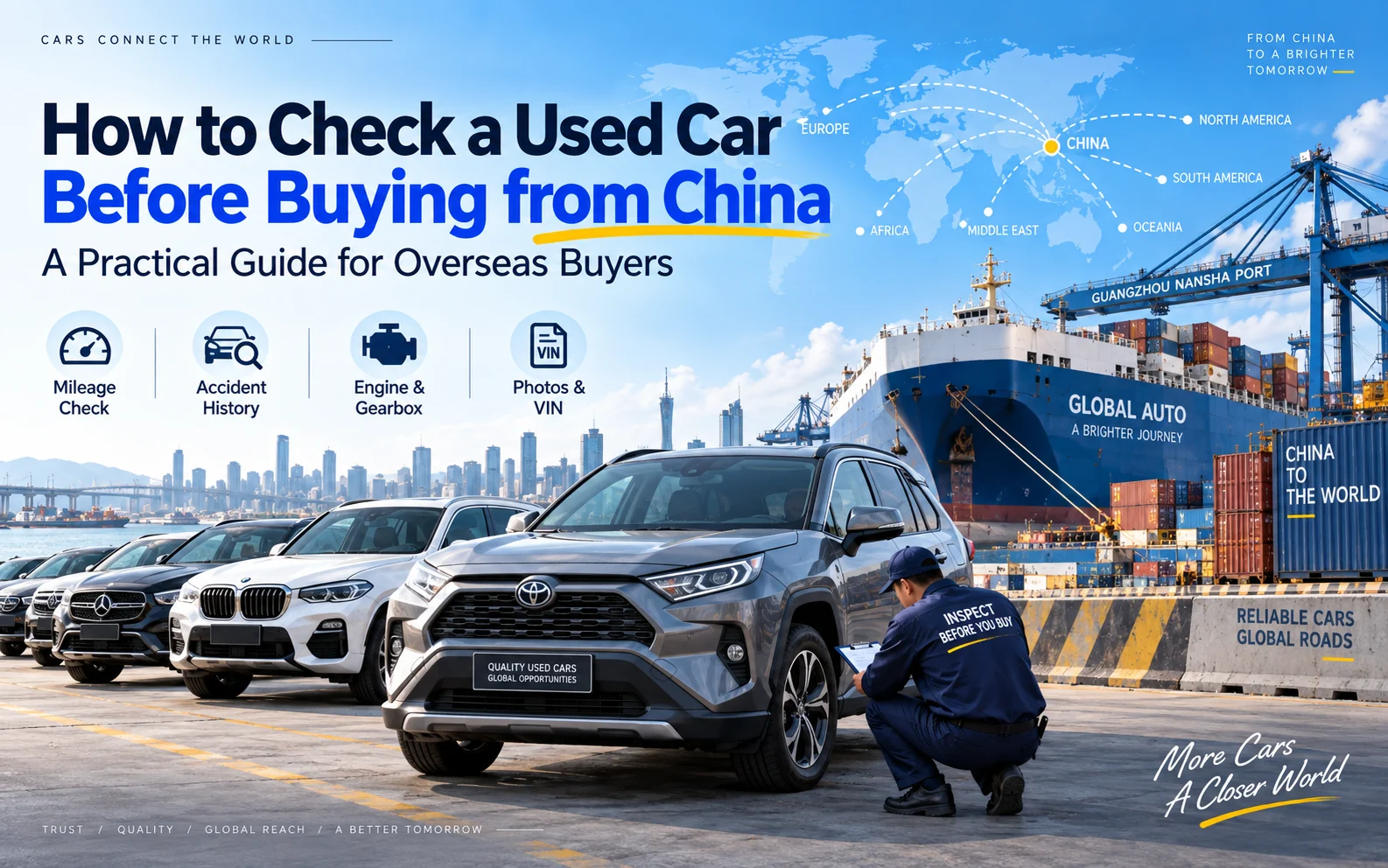
When buying a used car from China, price is important — but condition is even more important.
A car that is USD 500 cheaper is not necessarily a better deal if it has accident repairs, mechanical problems, excessive mileage, or poor maintenance.
For overseas buyers, there is another difficulty: you may not be able to inspect the vehicle in person before making a decision.
That means you need to know what to ask the seller, what photos and videos to request, and which parts of the vehicle deserve the most attention.
We work with overseas buyers looking for used vehicles from China, and one thing we always recommend is simple:
Do not make a buying decision based only on the model year, mileage, and price.
You should look at the complete condition of the vehicle.
Here is what we recommend checking before buying.
1. Confirm the Basic Vehicle Information First
Before looking at the condition, make sure the basic information matches what you are looking for.
Confirm the exact model, registration year, mileage, engine, transmission, trim level, fuel type, and VIN.
This sounds obvious, but different versions of the same model can have very different specifications.
For example, two Toyota RAV4 vehicles from the same year may have different engines, trim levels, equipment, or drivetrain configurations.
The registration date also matters.
A vehicle advertised as a certain model year may have a different first registration date, so overseas buyers should ask the supplier to clearly confirm the information shown on the vehicle documents.
If your country has vehicle-age restrictions, check the registration date before making a payment.
2. Check the Mileage — But Do Not Look at Mileage Alone
Mileage is one of the first things buyers ask about.
A car with 50,000 km will usually attract more attention than one with 120,000 km.
But mileage alone does not tell you whether the vehicle is in good condition.
A properly maintained higher-mileage vehicle can sometimes be a better purchase than a low-mileage car that has been poorly maintained or repaired after a serious accident.
Ask for a clear photo or video of the odometer.
If service records or maintenance information are available, compare them with the current mileage.
You can also look at the physical wear inside the vehicle.
For example, heavy wear on the steering wheel, driver's seat, pedals, and frequently used buttons may not always match an unusually low mileage reading.
There is no single sign that can prove a mileage problem, so the best approach is to consider several pieces of information together.
3. Look Carefully for Accident Repairs
This is one of the most important parts of buying a used vehicle.
Minor paintwork or a repaired bumper is very different from a vehicle that has suffered major structural damage.
Ask the seller whether the vehicle has had an accident and, if possible, request detailed photos of the body panels.
Look for differences in paint color, uneven panel gaps, signs of repainting, replaced body parts, unusual welding, or repaired areas around the chassis.
The front of the car deserves particular attention.
Check the hood, headlights, front bumper, radiator support, fenders, and the areas around the engine compartment.
The rear should also be inspected around the trunk floor, rear body panels, and spare-wheel area.
A used car does not need to be perfect.
Small scratches, dents, or repainted panels may be acceptable depending on the price.
The key is knowing the real condition before you buy it.
4. Check the Engine — Preferably From a Cold Start
A short video of an already-running engine tells you much less than a proper cold-start video.
If possible, ask the seller to start the vehicle when the engine is cold.
Listen for unusual knocking, rattling, or other abnormal noises during startup.
Watch the exhaust as well.
A small amount of condensation can be normal, especially in certain weather conditions, but persistent unusual smoke may require further inspection.
The engine bay should also be checked for obvious oil leaks, coolant leaks, damaged hoses, or signs of previous repairs.
After the engine starts, ask the seller to show the dashboard.
Warning lights should normally illuminate during startup and then switch off as expected.
If a warning light remains on, ask why before continuing with the purchase.
5. Do Not Ignore the Transmission
Engine condition gets most of the attention, but transmission problems can also be expensive.
For an automatic vehicle, ask the seller to demonstrate the car shifting between Park, Reverse, Neutral, and Drive.
When possible, a road-test video is even better.
Pay attention to delayed engagement, strong vibration, unusual noises, or very rough gear changes.
Different transmissions behave differently.
A traditional automatic, CVT, and dual-clutch transmission do not have exactly the same driving characteristics.
If you are buying a model known to use a particular type of transmission, it is worth checking that system carefully before purchase.
6. Check the Interior for More Than Appearance
A clean interior looks good in photos, but interior condition can also tell you something about how the vehicle was used.
Look at the driver's seat, steering wheel, gear selector, pedals, dashboard, door panels, buttons, and center console.
Check whether the wear appears reasonable for the age and mileage of the vehicle.
Ask the seller to test important electrical equipment such as the air conditioning, windows, mirrors, central locking, screen, cameras, lights, and other major functions.
For buyers in hot countries, air-conditioning performance can be particularly important.
You do not want to discover that the A/C system needs major repairs after the car has already arrived at your port.
7. Inspect the Chassis and Underside
The underside of the vehicle is easy to forget because it usually does not appear in normal sales photos.
Ask for chassis or underbody photos when possible.
Look for serious rust, oil leakage, damaged components, obvious repairs, or signs that the vehicle has suffered a strong impact underneath.
Suspension condition is also important.
During a road test, unusual knocking sounds over bumps can indicate worn suspension or steering components.
For an overseas buyer, repairing a small suspension problem may not be a major issue, but you should know about it before the vehicle is shipped.
8. Check the Tires and Brakes
Tires are consumable items, but replacing four tires immediately after the car arrives is still an additional cost.
Check the remaining tread and whether all four tires have relatively even wear.
Uneven tire wear can sometimes indicate alignment, suspension, or previous accident-related issues.
Also ask about the brakes.
During a road test, the vehicle should brake smoothly without serious vibration or pulling strongly to one side.
Again, used vehicles are not new vehicles.
Normal wear is expected.
The goal is to understand what may need maintenance after purchase so you can calculate the real cost of the car.
9. Ask for the VIN and Vehicle Documents
The VIN is the unique identification number of the vehicle.
Before purchasing, confirm that the VIN on the vehicle matches the available vehicle information and documents.
Ask your exporter what documents will be provided with the vehicle and what documents are required for export.
The exact documents you need at the destination can vary by country, so buyers should also check local customs and vehicle registration requirements.
This becomes especially important when importing vehicles into markets with restrictions based on vehicle age, engine size, steering position, emissions, or other technical requirements.
You should confirm these requirements before buying, not after the car has already been shipped.
10. Ask for Real Photos, Not Just Listing Photos
This is a simple rule that can prevent many problems.
Before paying for a used car, ask for actual photos of the exact vehicle you are buying.
A useful set of photos should show the front, rear, both sides, wheels, interior, seats, dashboard, odometer, engine compartment, trunk, VIN area, and any visible scratches or damage.
If there is a defect, ask for a close-up photo.
Do not be afraid to ask the seller directly:
“Can you show me the scratches or damaged areas?”
A serious exporter should be willing to show both the good and bad parts of a used vehicle.
Used cars naturally have imperfections.
It is better for the buyer to see them before payment than to discover them after the vehicle arrives.
11. Request a Continuous Walk-Around Video
Photos are useful, but video gives you another level of information.
We recommend asking for a continuous walk-around video of the exact car.
The video can start from the exterior, go around the entire vehicle, show the body panels and wheels, and then move inside to show the seats, dashboard, mileage, equipment, and engine.
If possible, ask for a startup video and a short driving video as well.
This does not replace a professional inspection, but it gives an overseas buyer a much better idea of the real vehicle condition.
It also helps confirm that the vehicle actually exists and matches the information in the quotation.
12. Consider a Third-Party Inspection
For higher-value vehicles, larger orders, or buyers purchasing from a supplier for the first time, an independent inspection can be worth considering.
A third-party inspector can check the vehicle separately from the seller.
Depending on the inspection service, they may check the body, engine, transmission, chassis, electronic systems, mileage, tires, interior, and other parts of the vehicle.
No inspection can guarantee that a used car will never develop a problem.
However, it can reduce uncertainty and give the buyer more information before making a final decision.
For dealers purchasing several vehicles, establishing a consistent inspection standard can also make future purchasing much easier.
13. Hybrid and Electric Cars Need Additional Checks
If you are buying a hybrid or electric vehicle, the normal used-car inspection is not enough.
Battery condition becomes an important part of the vehicle's value.
For an EV, buyers should ask about battery health information when available, charging condition, warning messages, charging equipment, and whether the charging standard is suitable for the destination market.
For a hybrid vehicle, the high-voltage battery should also be considered.
Battery condition cannot always be judged accurately from exterior photos or mileage alone.
If you plan to import EVs or hybrids regularly, it is worth establishing a separate inspection process for these vehicles.
14. Make Sure the Car Is Suitable for Your Market
A good car in China is not automatically the right car for your country.
Before buying, think about what happens after the vehicle arrives.
Is the vehicle left-hand drive or right-hand drive?
Are spare parts easy to find?
Is the engine size suitable for your country's tax system?
Can the model be registered locally?
Is there strong demand for the model in your market?
If you are a dealer, this becomes even more important.
Sometimes the cheapest vehicle is not the most profitable vehicle.
A slightly more expensive Toyota Corolla, Honda CR-V, Toyota RAV4, Hyundai Elantra, or another popular model may be easier to resell than an uncommon vehicle with a lower purchase price.
Your local market should influence your buying decision.
A Simple Used Car Inspection Checklist
Before making your final decision, make sure you have checked:
Vehicle model, registration year and VIN
Actual mileage
Exterior and paint condition
Accident and repair information
Engine condition and cold start
Transmission operation
Dashboard warning lights
Interior condition
Air conditioning and electronics
Tires and brakes
Chassis and underbody
Real vehicle photos
Walk-around video
Available inspection information
Export documents
Import requirements in your country
You may not need every item for every vehicle, but the more information you have before payment, the fewer surprises you are likely to have later.
Do Not Buy a Used Car Based on Price Alone
When overseas buyers compare vehicles, it is easy to focus on one number:
The price.
But a used car is not a standardized product.
Two cars can have the same brand, model, year, and mileage while being completely different in condition.
One may have original paint, a well-maintained interior, and good mechanical condition.
The other may have accident repairs and several items that need replacement.
That is why we prefer to look at the complete vehicle rather than simply finding the cheapest listing.
A good purchase is not necessarily the lowest-priced car.
It is a vehicle with a condition, specification, and total cost that make sense for your market.
Buying Used Cars from China?
If you are looking for a used vehicle from China, send us your requirements.
The most useful information includes your destination country, preferred model, registration year, quantity, budget, mileage requirements, and whether you are looking for an EXW or FOB quotation.
For available vehicles, we can provide actual vehicle information, photos, mileage, condition details, and videos so you can review the vehicle before making a decision.
If you are new to importing cars from China, you can also read our How to Import Used Cars from China: A Step-by-Step Guide for Overseas Buyers.
If you are not sure whether to choose EXW or FOB, see our guide to EXW vs FOB vs CIF vs DDP when importing cars from China.
Frequently Asked Questions
What should I check first when buying a used car from China?
Start with the exact vehicle information: model, registration year, mileage, VIN, engine, transmission, and overall condition. After that, check accident history, mechanical condition, photos, videos, and available inspection information.
Can I inspect a used car in China without visiting China?
Yes. Overseas buyers can request detailed photos, walk-around videos, cold-start videos, road-test videos, and vehicle inspection information. A third-party inspection can also be arranged when necessary.
Should I always choose a low-mileage car?
Not necessarily. Mileage is important, but maintenance history, accident condition, mechanical condition, and previous use also matter. A well-maintained vehicle with slightly higher mileage may sometimes be a better choice.
Is repainting a used car a serious problem?
Not always. Minor repainting can happen because of scratches or small body repairs. The important question is whether the car has only cosmetic repairs or has suffered major structural accident damage.
Should I request a cold-start video?
Yes, when possible. A cold start can provide useful information about engine startup, abnormal noises, exhaust condition, dashboard warning lights, and general engine behavior.
Is a third-party inspection necessary?
It depends on the value of the vehicle, the size of the order, and your relationship with the supplier. For expensive vehicles, multiple-car orders, or first-time purchases, an independent inspection can provide additional reassurance.
What information should I send when asking for a vehicle quotation?
Tell the exporter your destination country, vehicle model, preferred year, quantity, target budget, mileage or condition requirements, and whether you prefer EXW or FOB.